Beyond the Product: Why Experience Matters More to Kids and Families, by Adam Woodgate, Head of Research, The Insights Family.
Experience is becoming a more important part of how entertainment, brands, content and intellectual property (IP) fit into children’s and teens’ lives.
Far from physical products are losing relevance, the latest data from The Insights Family suggests that the relationship between product and experience is becoming more closely connected.
A toy can create shared play. Licensed clothing can allow a fan to express an identity. A character can turn cooking into a family activity. A sporting property can extend from the screen into playing, attending and wearing.
TrendLens is our monthly review of data across the 22 countries we survey produced for subscribers. Our latest 90-day analysis in the Americas (Argentina, Brazil, Canada, Mexico and the U.S., plus Turkey and Saudi Arabia), reveals a common theme: namely some of the most interesting movements are occurring when audiences have something to do and not just something to consume.
Families want to do things together
The change is particularly visible in family leisure.
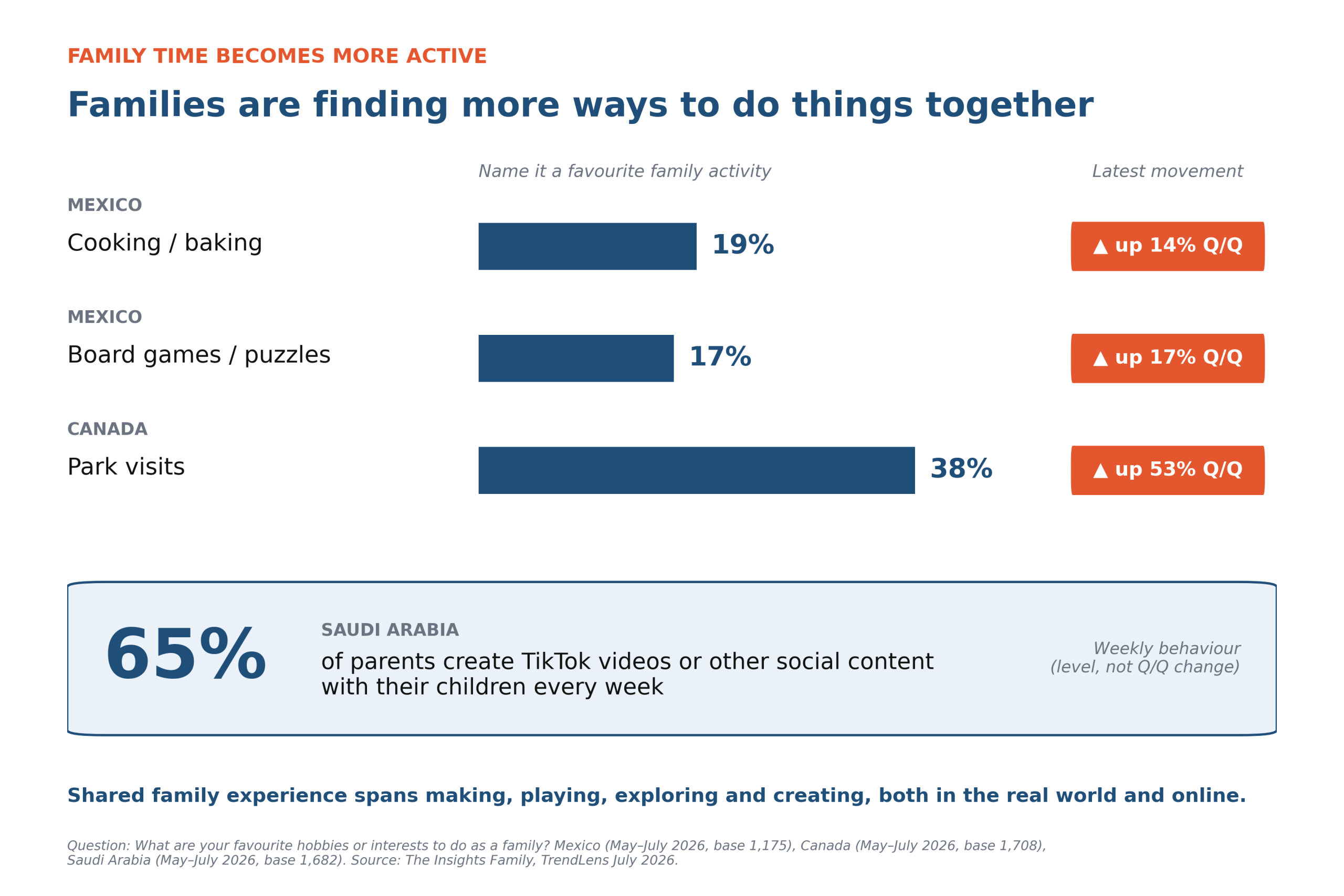
- In Mexico, 19% of parents now name cooking and baking among their favourite family activities, up 14% in just three months and 21% year-on-year. Animal-led days out have risen 17% quarter-on-quarter, while board games and puzzles are also up 17%. Among parents choosing these activities, 60% say enjoyment is part of their appeal, but 37% also value the opportunity they provide for family bonding.
- Canada provides another example. Park visits among kids increased from 25% to 38% in the latest quarter, while beach visits doubled from 10% to 20%. But children are not simply passengers on these family outings: 33% say they have strong influence over the family’s choice of days out, up 13% in three months.
For experience operators, licensees and IP owners, that creates an interesting challenge. An experience must appeal to the parent making the decision, but it also needs to give the child something sufficiently compelling to request, anticipate and participate in.
Experience doesn’t have to mean a destination
Perhaps more importantly, experience should not automatically be taken to mean a theme park visit, an attraction or ticketed event.
- In Saudi Arabia, 65% of parents say they create TikTok videos or other social content with their children each week. The number naming social-content creation as a favourite family hobby has reached 12%, increasing 13% in three months and 19% year-on-year. Cooking provides another example. Almost three-quarters of parents in the country cook or bake with their children weekly. Among these families, 61% say they prefer spending money on an experience rather than a product, 7% higher than average.
This opens interesting possibilities for licensing. A character-themed baking kit remains a physical product, but its value comes partly from the activity it enables. An in-person, real-world demonstration might start the experience, while recipes, products or online content
allow the family to recreate it at home.
The distinction between product and experience is therefore becoming less useful than it once was. Products can be the tools through which experiences happen.
Fandom becomes something fans can experience
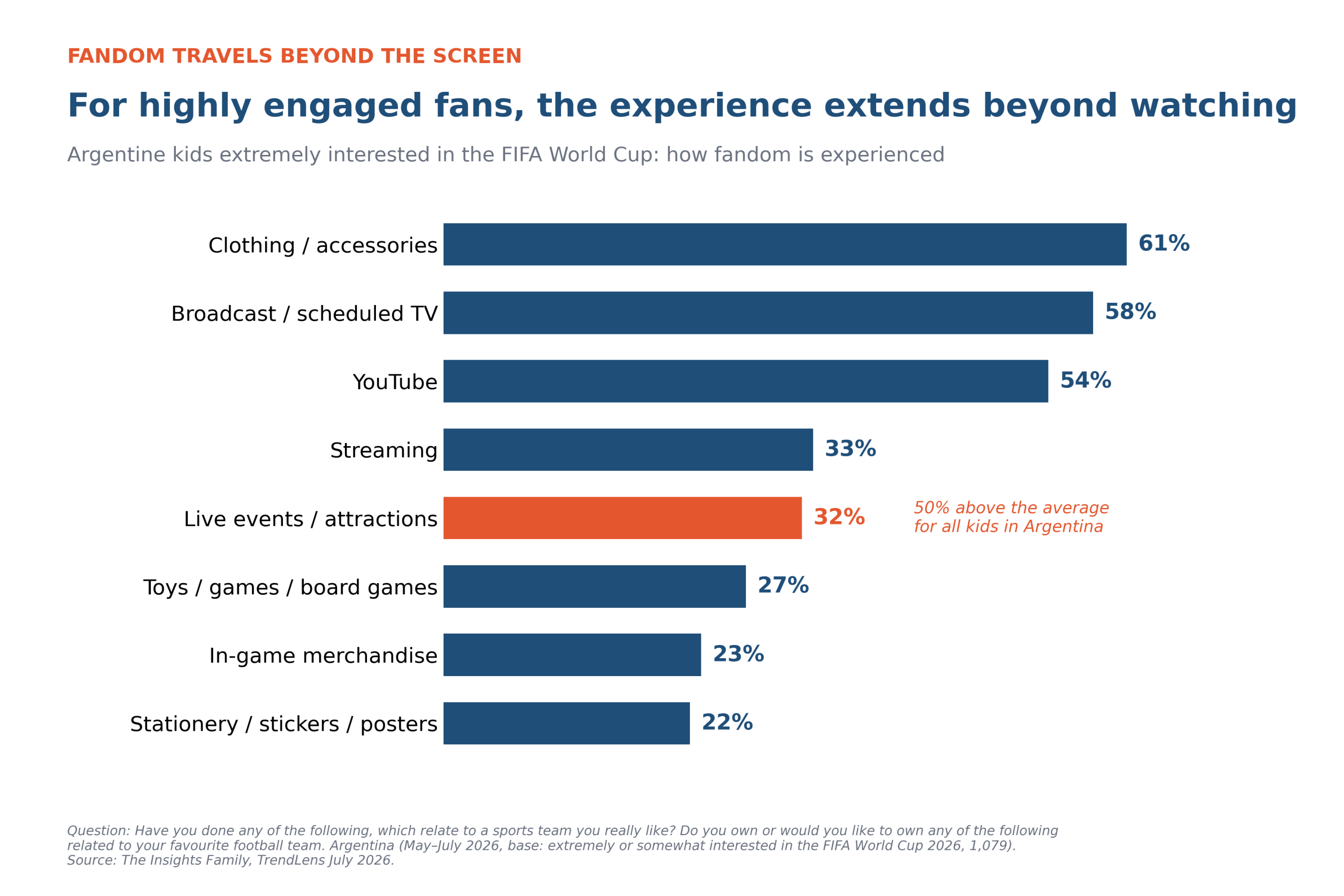
Sport provides perhaps the clearest demonstration. Among children in Argentina who are extremely interested in the FIFA World Cup, 61% own or would like related clothing and accessories, 27% engage with related toys, games or board games, and 23% with in-game merchandise. Their relationship goes further; it also extends into physical experience with 32% visiting a related live event or attraction, 50% above the average for all kids in the country.
What matters here is the ecosystem. The same fandom can move between watching, social media, gaming, merchandise and live experiences. For licensors, this suggests that the question is not simply which products fans might buy, but how each licensed touchpoint can give them another way to immerse themselves in the property.
That principle can apply well beyond sport. A restaurant collaboration can transform a meal into an entertainment moment. A collectible can provide a reason to visit and something to take home. A game can allow audiences to enter a fictional world rather than simply watch it.
Parents want value alongside enjoyment
- In Brazil, 43% of parents say they value family hobbies because they are educational or develop life skills, rising 19% in the latest 90 days. A further 33% value activities that support personal development, up 9% in the last three months. Meanwhile, the proportion considering something the family can play with together when buying toys has risen 12% to 30%.
- The U.S. reveals a similar direction. Activities with a cultural influence, such as attending festivals, visiting museums or places of interest, have risen 11% as a favourite family activity. Parents choosing them are 37% more likely than average to value their educational or life-skills benefits and 37% more likely to value personal development and growth.
None of this suggests children want their leisure turned into lessons; fun is essential. Instead, parents appear more receptive to experiences that combine enjoyment with another benefit: learning, creativity, development, discovery or simply spending significant time together.
From something to buy to something to remember
For the licensing industry, the opportunity is to connect products and experiences. The strongest licensed proposition might begin with a film, character, sports team or video game, become something a child wants to own, create an activity a family can enjoy together, and leave them with a reason to continue that relationship afterwards.
That makes experience more than a location or an event. It can be the role an IP gives people within its world. For brands and rights holders, perhaps the most useful question is therefore no longer simply, What can we make for this audience? but also What can we
enable them to do?
Written by: Adam Woodgate
Curated by: Cristina Angelucci