Record Growth, Home-Grown IP and the Rise of Sports and Virtual Idols.
All ten licensee industries grew year on year, Chinese-originated IP nearly doubled its licensing activity, and sports and virtual-character IP emerged as the fastest-moving categories. Here are the key facts, figures and trends from the 2026 China Licensing Industry Mid-Year Trends Report.
The 2026 China Licensing Industry Mid-Year Trends Report, presented at the 22nd China Licensing Industry Trends Conference, covers 1 July 2025 to 30 June 2026. It analyses 3,444 licensing cases involving 1,180 IPs and 235 active licensee brands across 10 licensee industries, supported by in-depth interviews with 50 leading companies. Comparisons refer to the previous twelve-month period (July 2024 to June 2025). Based on this data, the report identifies five development trends.

Facts and figures: a market in strong expansion
Every licensee industry grew.
Licensing activity rose in all ten licensee industries tracked. Four industries recorded more than 300 collaborations, and seven grew by more than 50%. Apps and consumer electronics saw the biggest jump, up 139.7% to 592 collaborations, making it the largest licensee sector, ahead of trendy toys (536, +67.0%), quick-service restaurants and tea drinks (387, +61.3%), and traditional toys (383, +3.8%).
Smaller categories also grew fast: food and beverage more than doubled (+125.0%, to 153), retail rose 86.7%, and jewellery 83.3%. Traditional toys (+3.8%) were the only large sector with flat activity, as licensing money moved toward electronics, trendy toys, and food service.
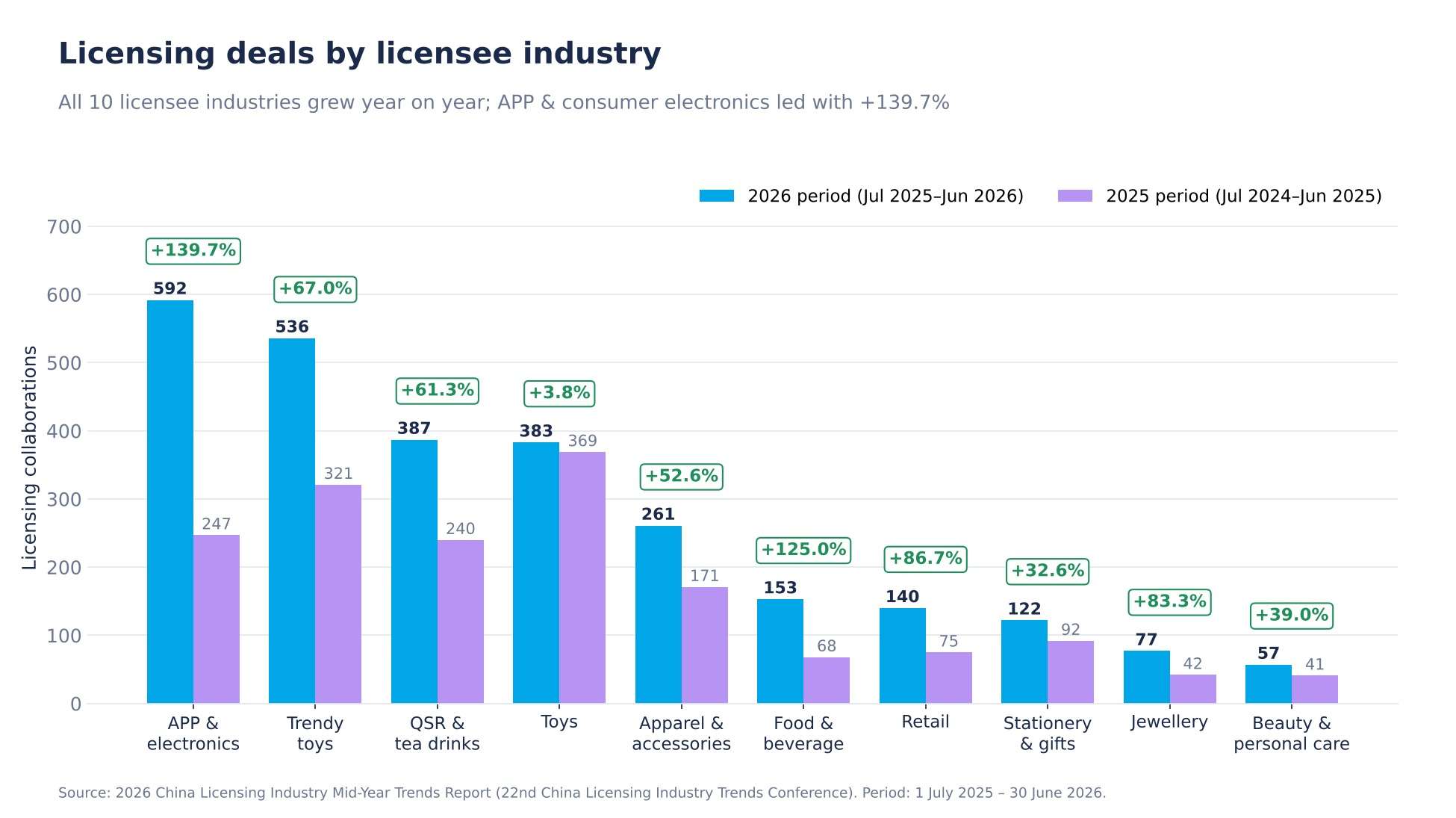
At brand level, 44.9% of active licensee brands increased their number of IP collaborations. In jewellery, all 10 top brands grew. In quick-service restaurants, tea drinks, trendy toys, and retail, more than 70% of the brands surveyed increased their IP partnerships.
IP categories: six categories more than doubled
Cartoon and animation remains the largest IP category by far, with 1,055 collaborations (+44.9%). Film, TV and variety shows (566, +142.9%) and characters and personalities (511, +131.2%) also passed 500 deals. Video games (498, +138.3%) were close behind.
Six categories more than doubled year on year. Sports IP grew fastest, up 157.1%, followed by film and TV, video games, characters and personalities, institutions and celebrities (+114.3%) and books and music (+100%). Corporate brands were the only category to decline, slipping 5.1% to 409 collaborations.

The leading IPs
Twenty-one IPs recorded 20 or more collaborations with active licensee brands. Sanrio's character family ranked first with 79, well ahead of Zootopia (49) and Toy Story (46). Crayon Shin-chan and My Little Pony followed with 36 each, then The British Museum (31), Panda Home (28) and Hatsune Miku (27).
The ranking mixes global entertainment franchises with Japanese anime classics (Detective Conan, Ultraman, Chiikawa, Neon Genesis Evangelion, Pokémon), museum IP (The British Museum and the V&A), and one Chinese video game, Eggy Party, with 24 collaborations.

Trend 1 – The licensing industry keeps growing
The first trend is overall growth. Every licensee industry expanded; almost half of brands increased their IP partnerships, and the number of high-volume IPs grew. Licensing is now standard for how Chinese consumer brands launch products and market themselves, especially in electronics, trendy toys, and food service.
Trend 2 – Sports IP heats up, and partnerships become multi-party
World-class events lead, local and club IP grow fastest.
Sports IP licensing rose sharply at every level. World-class sports IP recorded the most activity, rising from 6 to 29 collaborations. City-level sports IP, which targets specific local fan communities, grew sixfold, from 2 to 12. Club and team IP rose from 10 to 17 (1.7 times the previous level), and national-level IP from 10 to 14.
By sport, major ball sports led with 34 collaborations, up from 12 (2.83 times the previous level), and motor racing rose from 3 to 11 (3.67 times). Multi-sport games (6) and niche sports such as wrestling, sailing, dragon-boat racing, cycling, winter and extreme sports (5) had no licensing deals the year before.
Among individual properties, the FIFA World Cup led with 10 collaborations and Formula 1 recorded 8. The NBA, the Jiangsu Football City League (“Su Chao”), and China’s National Games each had 4.
From single licences to multi-party collaborations
Sports licensing is moving away from simple one-IP, one-brand deals towards multi-party collaborations. These combine product co-creation with joint marketing. Disney x Formula 1® is the main example: the combined property was licensed to 52TOYS, JUST FOTO, GENTLE MONSTER, MINISO and UNIQLO.
The FIFA World Cup was used in the same way, for example, in FIFA World Cup × Mengniu × Hisense and FIFA World Cup × LABUBU × Coca-Cola.
Case study: LABUBU at the World Cup
Licensee brands are not just making products. They are also using the attention around major sporting events for brand marketing. LABUBU appeared at the 2026 FIFA World Cup opening ceremony on 12 June (Beijing time), which brought the trendy toy brand to football fans.
The hashtag “#LABUBU made it to the World Cup” trended on Chinese social media; the #LabubuWorldCup topic passed 200 million views in one week, and more than 120,000 related posts were published. The co-branded collection sold out as soon as it went live on livestream channels, and Pop Mart’s share price closed 2.64% higher that day. Quick-service restaurant and tea-drink brands go further, building pop-up stores at sports venues that combine atmosphere and product experience to reach Gen Z consumers. Examples include Tour of Guangxi × Cotti Coffee, Wuhan Marathon × Nowwa Coffee and FISE Extreme Sports World Series × Subway.
Trend 3 – Chinese-originated IP: more IPs and more deals
Home-grown IP nearly doubles.
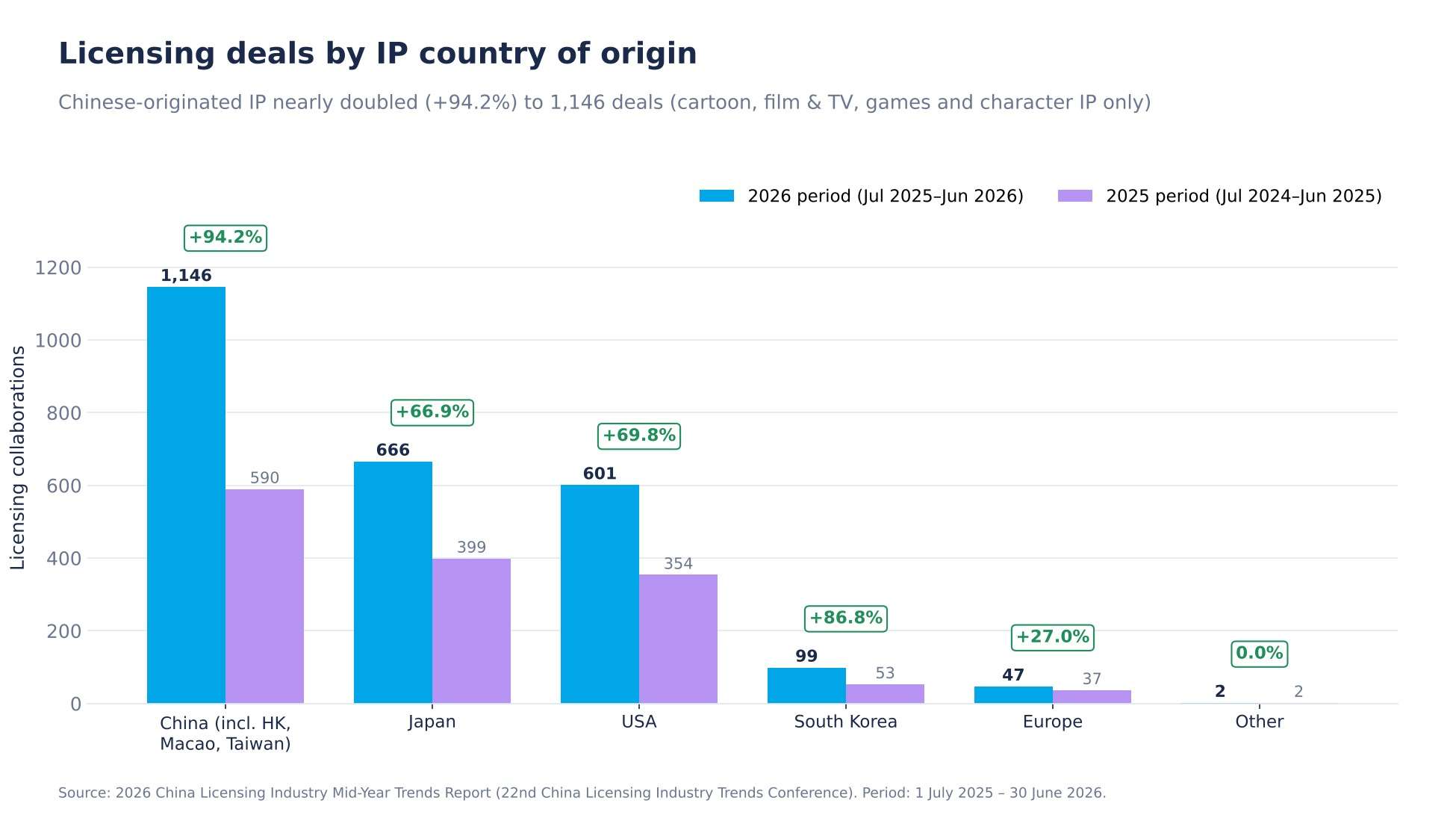
Chinese-originated IP (known in China as guochuang) recorded the strongest growth of any origin. Across the four core categories (cartoon and animation, film and TV, video games, and characters and personalities), Chinese IP, including Hong Kong, Macao and Taiwan, reached 1,146 collaborations, up 94.2%. That is well ahead of Japanese IP (666, +66.9%) and US IP (601, +69.8%). Korean IP grew 86.8% to 99, and European IP grew 27.0% to 47.
Video games are the most active category of Chinese IP, with 361 collaborations, more than double the previous year’s 174. Cartoon and animation followed with 254 (from 128), then characters and personalities with 243 (from 89), film and TV with 208 and trend and fashion with 80.
The number of Chinese IPs on the market is also growing. Characters and personalities grew fastest, up 165.4% to 138 IPs. Film and TV (109), characters and personalities (138) and video games (110) each now have more than 100 active IPs.
Games lead the way: Eggy Party and GG Bond.
The most-licensed Chinese games were Eggy Party (24 collaborations with active licensee brands), Honour of Kings (18) and Wuthering Waves (16). Arknights and Love and Deepspace had 12 each, followed by Identity V (11), Light and Night and Path to Nowhere (9 each), Honkai: Star Rail and Persona5: The Phantom X (8 each).
Eggy Party recorded 88 licensing deals in total, across food service, apparel, trendy toys, stationery and automotive. Its KFC collaboration sold out early in stores across several cities and passed one million units. The campaign hashtag reached 400 million reads on Weibo and trended nationally; related topics reached 550 million views on Douyin, and posts on Xiaohongshu were viewed 41.9 million times.
The animated character GG Bond (Zhu Zhu Xia) recorded 10 collaborations with active licensee brands and 21 in total, across food service, toys, games, consumer electronics and retail. Its partnership with JD Takeaway generated more than 1 billion impressions across Douyin, Weibo and Xiaohongshu. The co-branded T-shirt sold 200,000 units, and QR-code traffic passed one million scans.
Trend 4 – Virtual-character IP grows fast as a fan-economy tool
More IPs, more deals, more industries
Virtual-character IP, which covers virtual idols, avatars and celebrity alter egos, was one of the fastest-growing segments. The number of active virtual IPs rose from 5 to 27, and their licensing collaborations from 15 to 70. The number of licensee industries using them went from 4 to 9. The top industry shifted from toys and trendy toys to apps and consumer electronics, with collaborations rising from 4 to 28.
Hatsune Miku and AI-powered virtual idols
Virtual idols use AI technology to upgrade their look, content, and how they reach fans, and they have become a major source of attention among young consumers. Hatsune Miku is the leading example, with 27 licensing collaborations (up from 9) in consumer electronics, beauty and food service, including Pizza Hut. Her Weibo topic reads rose from 1.12 billion to 3.05 billion.
Celebrities enter the market with virtual alter egos.
More celebrities are launching virtual IPs that draw on their large fan bases. Celebrity virtual IP licensing in China rose from 1 to 11, and their collaborations from 1 to 17. Examples include Jay Chou’s “Zhou Tongxue” × Zhu Bingren Copper, table-tennis champion Wang Chuqin’s “HOHO” × Mistine, actor Ding Yuxi’s “Xiao Qiezi” × Champion, singer Silence Wang’s “Su Long” × Molly Tea, Zhou Shen’s” Zhou Keke” × Pop Mart, and Mayday’s “MOJO FAMILY” × Lao Miao.
The most ambitious project was Finding Zhou Tongxue, a city cultural-tourism tour across Shanghai, Hangzhou and Beijing. It combined landmark check-ins, licensed partnerships, pop-up stores in shopping districts and official city tourism partnerships. The Shanghai edition (13 September to 12 October 2025) generated more than 300 million impressions and nearly 1.45 million participants. Footfall in the six participating shopping districts rose by an average of 30%, and their revenue by 18%. Themed transport by land, water and air carried more than 220,000 users. Tie-ins included the Rolex Shanghai Masters, a Shanghai Museum art show and DiDi’s Qingju
bike-sharing service.
Trend 5 – Licensee brands bring their own IPs into collaborations
Licensee brands increasingly create and refresh their own IP. They now use it alongside licensed IP for product co-creation and marketing, rather than licensing only external properties. The report identifies three models.
- Own IP as the vehicle for collaborations. Tea brand LINLEE uses its duck mascot as the face of its co-brandings, with partners including Overwatch × Naraka: Bladepoint, Shanghai Zoo, Goose Goose Duck and Sky: Children of the Light. This drives fan traffic and interaction.
- Co-creating content with external IP. Apple Gal × Teenie Weenie generated more than RMB 18 million in GMV on launch day and topped Douyin’s flagship-store sales chart.
- Joint content marketing between two IPs. Duolingo × Luckin Coffee built a storyline in which the two brands’ characters interact. After the 2025 “wedding announcement” short drama, the co-branded products sold more than 9 million cups in the first week. In 2026, a “baby announcement”; sequel drove more than 600,000 topic views within a day of the new products’ launch, and both brands gained 23% more followers in the first week than in the same period the year before.
What to watch
For licensors, agents and brands looking at China, the report points to five priorities for the year ahead:
- Look beyond toys. Electronics, food service and food and beverage are now the fastest-growing licensee sectors.
- Sports is the breakout category. Global events, city leagues, and niche sports are all opening up, and multi-party deals are multiplying visibility.
- Chinese IP is a serious competitor and partner. Games in particular now match or exceed many international properties in licensing activity.
- Virtual and celebrity avatars are reaching the mass market. AI-enhanced virtual idols and celebrity alter egos offer large fan bases and new ways to tie into offline places and tourism.
- Co-branding is becoming two-way. Licensees with their own mascots and storylines expect partnerships to focus on content, not just a logo on a product.